EXECUTIVE SUMMARY
Most transformations do not fail because of a catastrophic decision.
They fail because momentum quietly disappears.
Transformation success depends less on the roadmap and more on maintaining focus, urgency, ownership, and leadership attention over time.
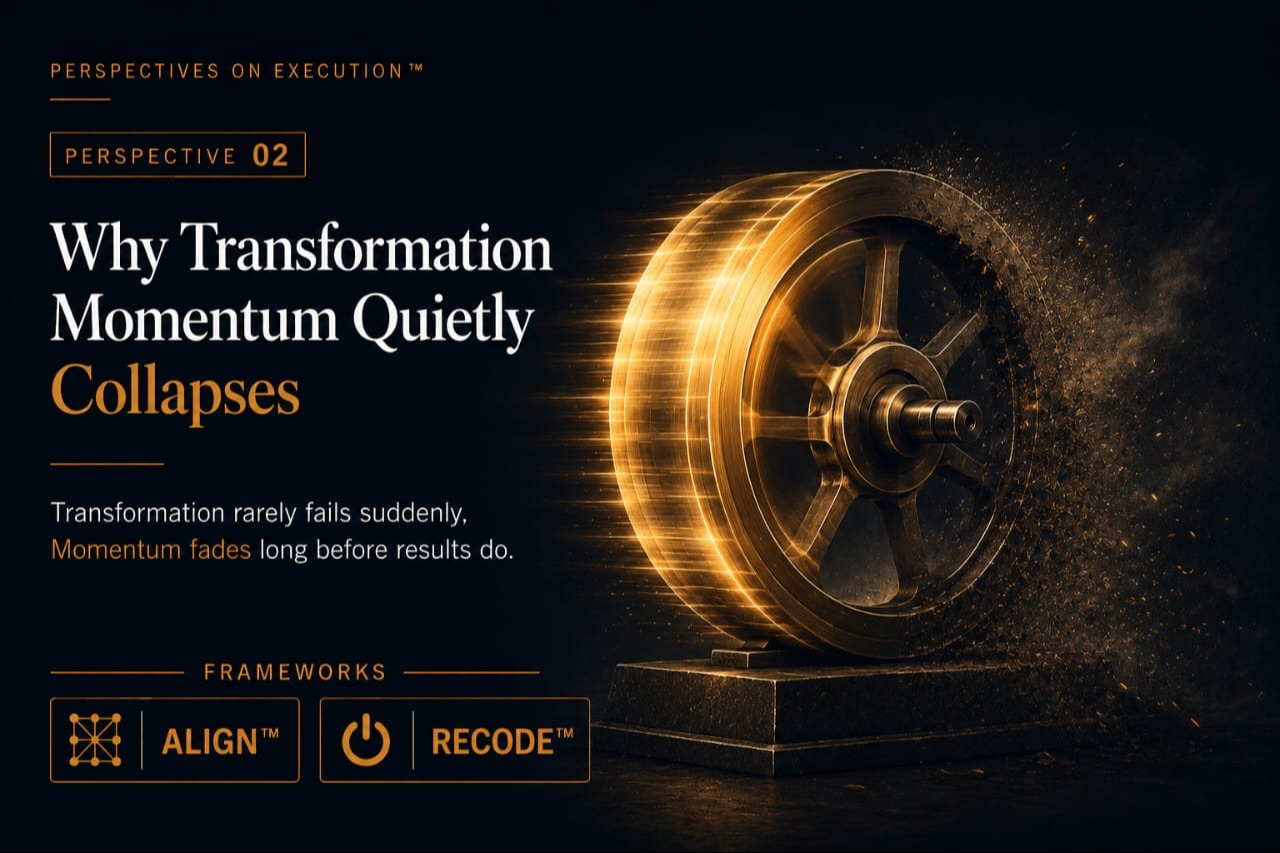
WHY TRANSFORMATION MOMENTUM QUIETLY MOMENTUM QUIETLY COLLAPSE
Most transformation programmes do not fail because of a single catastrophic decision.
In my experience, they fail because momentum quietly disappears.
"Transformations rarely fail suddenly. Momentum fades long before results do."
The organisation launches with energy. The leadership team is aligned. The ambition is clear. A transformation office is established. Workstreams are defined. Targets are agreed. There is excitement about what the future could look like.
For a while, everything appears to be moving in the right direction.
Then reality arrives.
Business performance still has to be managed. Customers still need attention. Operational issues still emerge. Leaders become consumed by competing priorities. New initiatives are introduced. Urgent matters begin to crowd out important ones.
The transformation does not stop overnight.
It simply becomes one more thing competing for attention.
I have seen this pattern repeatedly across organisations. The programme remains active. Meetings continue. Status reports are produced. Steering committees still take place. Yet beneath the surface, something important has changed.
The transformation is no longer driving the organisation.
The organisation is now driving the transformation.
"The moment the business starts driving the transformation, momentum begins to erode."
Once that happens, momentum begins to erode.
Decisions take longer. Dependencies remain unresolved. Risks stay open for months. Workstreams lose urgency. Teams become focused on activity rather than outcomes. Leadership discussions shift from value creation to progress reporting.
Nobody intends for this to happen.
In fact, most organisations are surprised when they realise how much momentum has been lost.
The challenge is that transformation requires a different level of focus and discipline than day-to-day operations. Running the business and changing the business are not the same thing. Both are important, but they compete for leadership attention.
This is why some organisations struggle even when they have capable leaders, committed teams, and a well-designed transformation roadmap.
The missing ingredient is often not strategy.
It is ownership.
Specifically, ownership for maintaining momentum.
Someone must wake up every day focused on the health of the transformation. Someone must challenge delays, resolve barriers, connect workstreams, escalate decisions, track value delivery, and ensure that leadership attention remains focused on what matters most.
Without that role, transformation gradually becomes part-time work.
And part-time transformation rarely delivers full-time results.
"Part-time transformation rarely delivers full-time results."
The organisations that sustain momentum understand this. They recognise that transformation is not a project to be reviewed periodically. It is a leadership discipline that requires constant orchestration across functions, priorities, and stakeholders.
That is why the most successful transformations often have a dedicated leader whose primary responsibility is not running a function, but ensuring the transformation itself succeeds.
Because transformation rarely collapses in a dramatic moment.
It fades through a thousand small compromises, delayed decisions, and competing priorities.
And by the time those signs become visible, significant value has often been left on the table.
---
If your organisation has a transformation agenda but is struggling to maintain momentum, the challenge may not be the programme itself.
It may be the absence of dedicated transformation leadership.
Learn more about Praxis AdvisoryTM Embedded Transformation Leadership or discuss a Fractional Chief Transformation Officer engagement.
RELATED PRAXIS FRAMEWORKS
ALIGNTM
Align leadership, priorities, governance, incentives, and execution.
RECODETM
Embed new behaviours, routines, and execution habits required for sustained transformation.
Losing Momentum?
Most transformations do not collapse because the strategy was wrong.
They collapse because momentum quietly disappears beneath competing priorities, delayed decisions, and leadership distraction.
SCHEDULE EXECUTIVE ALIGNMENT CONVERSATIONMORE PERSPECTIVES ON EXECUTIONTM
Perspective 01
Why Transformation Momentum Quietly Collapses
Perspective 03
Leadership Alignment Is Often The Real Strategy Problem
Perspective 04

Perspective 05
Lorem ipsum dolor sit amet, metus at rhoncus dapibus, habitasse vitae cubilia odio sed. Mauris pellentesque eget lorem malesuada wisi nec, nullam mus.