EXECUTIVE SUMMARY
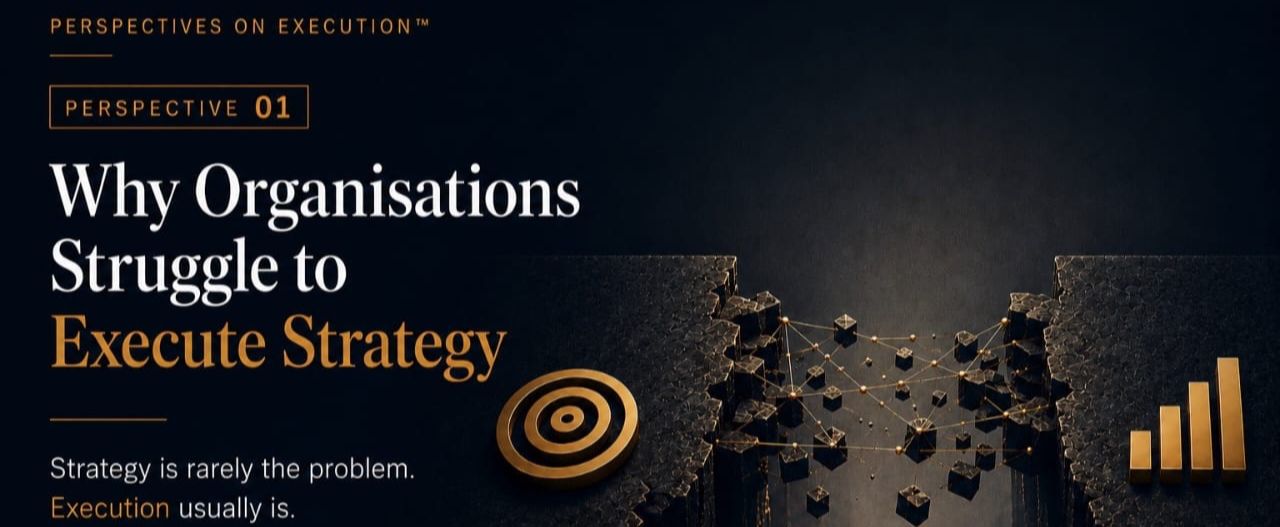
Most organisations do not struggle because they lack strategy.
They struggle because they underestimate execution.
The issue is rarely strategic intent.
The issue is usually the execution system operating beneath it.
This box should be visible without significant scrolling.
WHY ORGANISATIONS STRUGGLE TO EXECUTE STRATEGY
One of the most common conversations I have with leaders goes something like this: "We have a good strategy, so why aren't we seeing the results?"
Over the years, I have seen this challenge from multiple vantage points: as an employee, as a transformation leader, as an advisor, and as someone sitting in leadership team meetings trying to move critical initiatives forward.
One observation keeps repeating itself. Most organisations do not struggle because they lack strategy. They struggle because they underestimate execution.
"Most organisations do not struggle because they lack strategy. They struggle because they underestimate execution."
I have worked in organisations where the strategy was developed by some of the smartest people in the business. I have seen boards spend months debating priorities and CEOs articulate compelling visions that inspired entire organisations.
I have also seen consulting firms deliver beautifully researched strategy documents backed by rigorous analysis and world-class thinking. Everyone knew where the organisation was trying to go.
Yet months later, and sometimes years later, many of the expected outcomes remained stubbornly out of reach.
The reason was rarely a flawed strategy. It was not a lack of commitment, and it certainly was not a lack of activity. In fact, activity is rarely the problem. Most organisations are incredibly busy. The real challenge is that activity and execution are not the same thing.
"Activity and execution are not the same thing."
What I have observed repeatedly is that organisations assume execution will happen naturally once the strategy has been agreed.
A strategy is approved, projects are launched, owners are assigned, targets are communicated, and everyone returns to the demands of daily operations. That is usually where the trouble begins.
Priorities start competing for attention. New initiatives emerge. Decisions take longer than they should. Leadership attention shifts elsewhere. Meetings become reporting forums rather than decision forums.
Teams remain busy, but momentum begins to slow. Not dramatically. Gradually. Almost invisibly. Until one day leaders realise they are significantly behind where they expected to be.
When that happens, the instinct is often to revisit the strategy. In my experience, that is rarely where the answer lies. The more important question is: what execution system is operating beneath the strategy?
How is progress reviewed? How are priorities reinforced? How are decisions accelerated? How is accountability maintained? How quickly are obstacles surfaced and resolved? How does leadership ensure focus survives beyond the launch event?
These questions matter because execution is not a project, a workshop, or a communication campaign. It is a management system.
The organisations that consistently outperform others are not necessarily those with the most brilliant strategies. More often, they are the ones that have built disciplined systems for translating strategic intent into daily action.
They understand that execution requires clarity around what matters most, cadence that keeps priorities visible, accountability that drives follow-through, and governance mechanisms that surface issues before they become failures.
That is why I have become increasingly convinced that strategy is only half the challenge. The other half is building the execution architecture required to make the strategy real. Strategy rarely fails in the boardroom. It fails in the months and years that follow.
"Strategy is only half the challenge. The other half is execution architecture."
Organisations that understand this gain an advantage that is surprisingly difficult for competitors to replicate. They do not just plan well. They execute well.
---
If your organisation has a clear strategy but is struggling to convert ambition into measurable results, the issue may not be the strategy itself. It may be the execution system operating beneath it.
Explore the Praxis Execution Operating SystemTM or discuss an execution diagnostic with Praxis AdvisoryTM.
RELATED PRAXIS FRAMEWORKS
C3TM
Diagnose execution bottlenecks, leadership friction, and performance constraints.
ALIGNTM
Align strategy, governance, incentives, accountability, and execution.
Strategy Is Rarely The Problem.
If your organisation has a clear strategy but is struggling to convert ambition into measurable results, the issue may not be the strategy itself.
It may be the execution system operating beneath it.
SCHEDULE EXECUTIVE ALIGNMENT CONVERSATIONMORE PERSPECTIVES ON EXECUTIONTM

Perspective 02
Why Transformation Momentum Quietly Collapses
Perspective 03
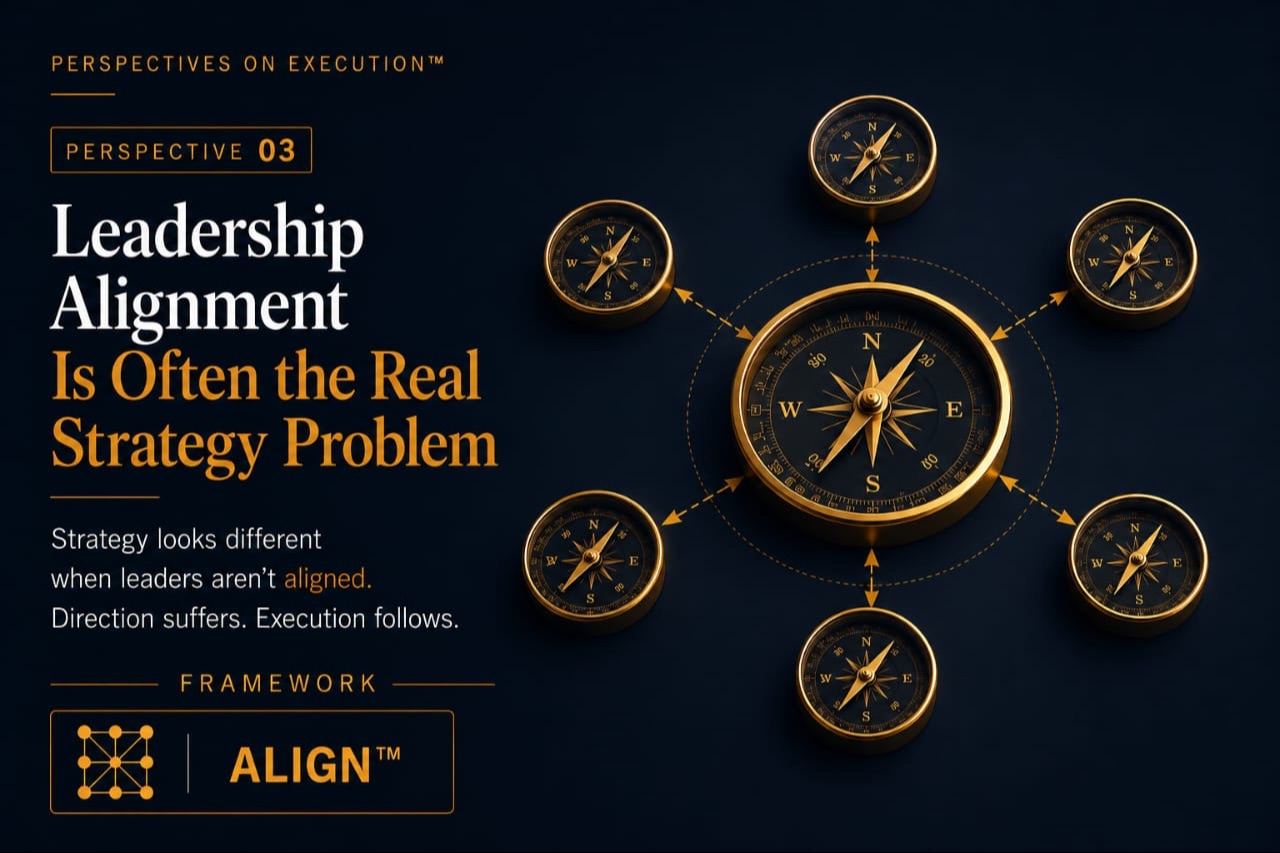
Leadership Alignment Is Often The Real Strategy.

Perspective 04
Governance Rhythm Matters More Than Most Organisation Realise

Perspective 05
Strategy Drift Rarely Happens Suddenly