EXECUTIVE SUMMARY
Most transformations do not fail because of a catastrophic decision.
They fail because momentum quietly disappears.
Transformation success depends less on the roadmap and more on maintaining focus, urgency, ownership, and leadership attention over time.
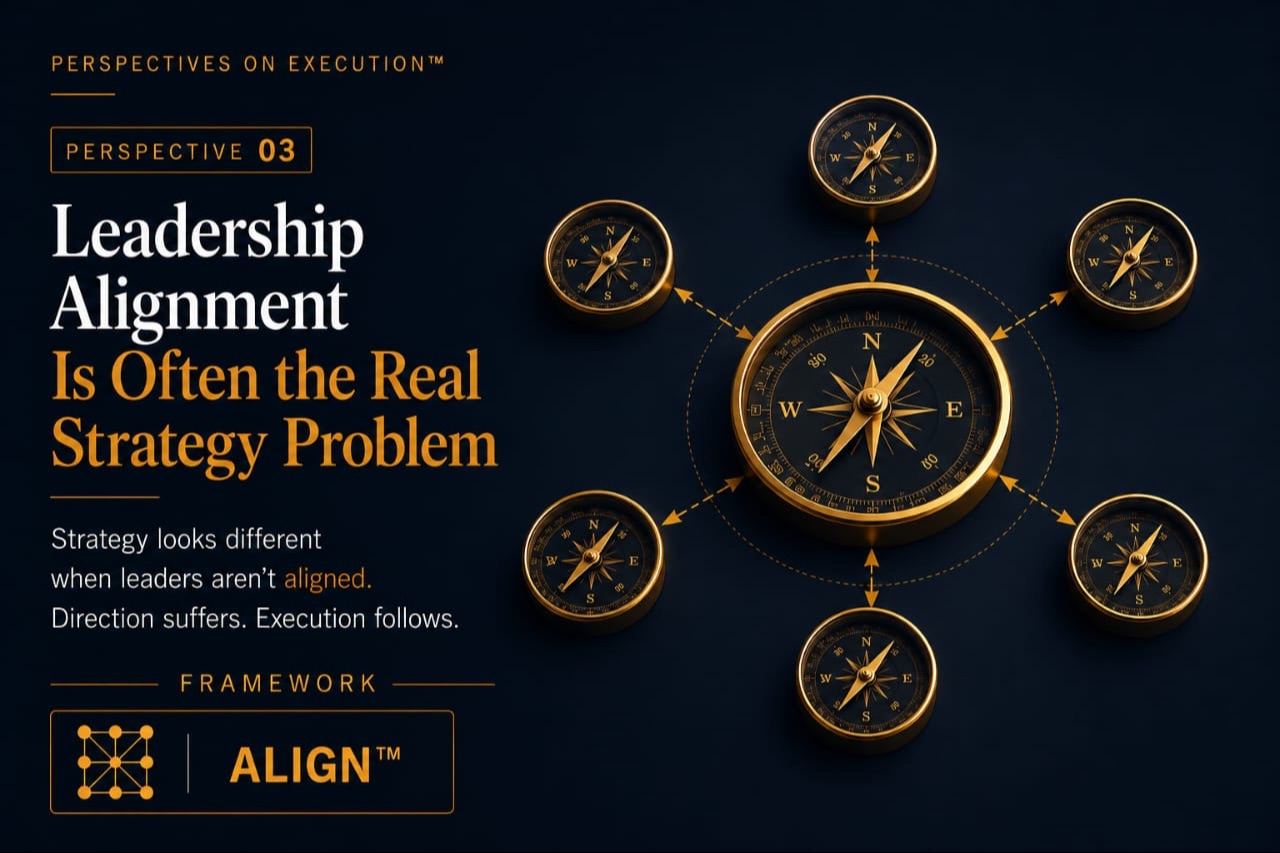
LEADERSHIP ALIGNMENT IS OFTEN THE REAL STRATEGY PROBLEM
When organisations struggle to execute strategy, the first instinct is often to question the strategy itself.
Should we change direction?
Are our priorities still correct?
Do we need a new strategic plan?
In my experience, the strategy is rarely the problem.
More often, the real challenge is leadership alignment.
The strategy is rarely the problem. Leadership alignment usually is.
I have seen organisations with highly capable leadership teams, clear strategic priorities, and well-developed plans struggle to deliver expected results. On paper, everyone appeared aligned. In leadership meetings, there was broad agreement about the organisation's direction. Yet execution remained inconsistent and performance fell short of expectations.
The reason became apparent when you looked beneath the surface.
Different leaders were interpreting the same strategy in different ways.
What one executive considered a priority, another viewed as secondary. What one function believed was urgent, another saw as optional. Teams received different messages depending on who they spoke to. Decisions reflected functional perspectives rather than enterprise priorities.
The result was not conflict.
The result was fragmentation.
"Fragmentation is one of the most expensive forms of organisational waste."
Resources become dispersed. Effort becomes diluted. Teams receive mixed signals. People work hard, but not always in the same direction.
This challenge is particularly common after strategy sessions, leadership retreats, and annual planning exercises. Leaders often leave the room believing alignment has been achieved because there is agreement on the destination.
The reality is that alignment is not agreement on where you are going.
"Alignment is agreement on what matters most."
Alignment is agreement on what matters most, how success will be measured, what trade-offs will be made, how decisions will be taken, and how leaders will behave when priorities inevitably compete.
That level of alignment requires more than a strategy document.
It requires a shared execution language.
It requires a common understanding of priorities.
It requires agreed operating rhythms.
It requires leadership disciplines that are consistently reinforced across the organisation.
The highest-performing organisations I have worked with invest significant time building this capability. They do not assume alignment exists simply because a strategy has been approved. They treat alignment as an organisational capability that must be deliberately developed and maintained.
That capability becomes increasingly important during periods of transformation, growth, uncertainty, or organisational change. As complexity increases, the cost of misalignment increases with it.
The organisations that execute most effectively are not necessarily those with the smartest leaders.
They are often the ones whose leaders have learned how to operate as a genuinely aligned leadership system.
Because strategy does not fail when leaders disagree publicly.
It often fails when leaders appear aligned but execute differently.
---
If leadership alignment remains dependent on individual personalities, informal conversations, or periodic strategy retreats, it may be time to build stronger organisational execution capability.
Learn more about Praxis AdvisoryTM Capability Building programmes and leadership execution workshops designed to help organisations create a shared execution language, stronger alignment, and more consistent delivery.
RELATED PRAXIS FRAMEWORKS
ALIGNTM
Create alignment across leadership, priorities, governance, incentives, and execution.
Leadership Team Misaligned?
When leaders interpret priorities differently, organisations slow down.
Decisions become inconsistent.
Resources become fragmented.
Execution suffers.
The issue is rarely intent.
The issue is alignment.
SCHEDULE EXECUTIVE ALIGNMENT CONVERSATIONMORE PERSPECTIVES ON EXECUTIONTM
Perspective 01
Why Transformation Momentum Quietly Collapses
Perspective 02
Leadership Alignment Is Often The Real Strategy Problem
Perspective 04
Governance Rhythm Matters More Than Most Organisation Realise

Perspective 05
Strategy Drift Rarely Happens Suddenly